Spenlow and Jorkins
David CopperfieldSpenlow and Jorkins is an ecclesiastical-law firm in Doctors' Commons, and the professional setting in which David Copperfield first encounters legal work from the inside. Its business encompasses wills and marriages as well as disputes involving ships and boats; its files and court appearances give David an education in institutional routine. But the firm is also a study in the gap between legal form and responsibility. Under Mr. Spenlow and Mr. Jorkins, a polished appearance of personal benevolence conceals a business governed by fees, competition, and the shifting of blame.
Place and professional work
David first approaches the firm with Betsey Trotwood, who is seeking a respectable occupation for him. The route into Doctors' Commons passes through a low archway and a series of narrow courts before reaching the offices of Spenlow and Jorkins, where copyists work among bundles of legal papers. The setting is quiet and enclosed, separated from the city by a threshold that seems to soften its noise. For David, the paperwork itself offers an initial attraction: the desks hold allegations and libels, files associated with the Consistory Court and the Court of Arches, and large, bound collections of evidence taken on affidavit. He sees in the accumulated records the substance and apparent seriousness of a proctor's profession.
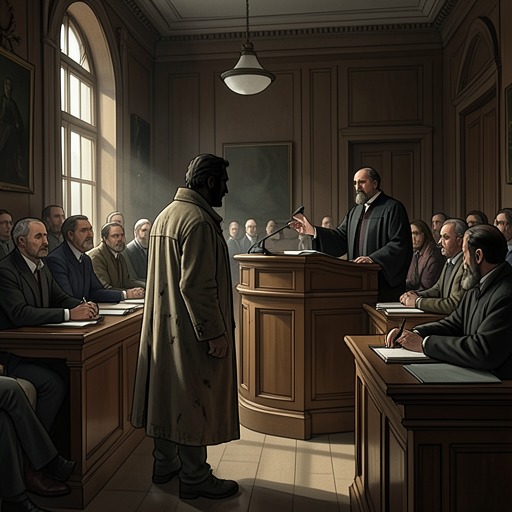
The cases show how broad and specialized that profession is. The legal business described at Doctors' Commons includes disputes about wills and marriages, ecclesiastical proceedings, and cases involving ships. David is told that maritime disputes and church matters can pass through the same institution and be handled by the same professional community. In court, he sees advocates in black gowns trimmed with white fur, doctors in red gowns and grey wigs, and a judge presiding from the curved platform. The judicial machinery is presented as both formal and oddly theatrical: roles shift, arguments proceed through voluminous evidence, and the proceedings take place before a sparse public audience.
The firm's business also exposes the difference between legal validity and justice. In one divorce case, a husband obtains the court's confirmation that he was not legally married after having used only part of his name on his marriage licence and later relying on the omitted name to contest the marriage. David doubts the fairness of the result, while Mr. Spenlow treats it as one of the anomalies belonging to a larger system. The episode makes the firm's professional world more than a backdrop to David's career: it gives him an early view of how technical rules can decide intimate matters without resolving the moral question of whether the decision is fair.
Recruitment and the partnership's public face
When David considers entering the profession, Mr. Spenlow offers a month's probation, though he says he would willingly allow a longer trial if not for the presence of his partner. The premium for the articles, including the stamp, is one thousand pounds. Mr. Spenlow presents himself as reluctant to insist on the sum and suggests that Mr. Jorkins is the immovable party. He also indicates that a salary would be beyond his power to arrange for an articled clerk, again attributing the constraint to his partner.
Mr. Jorkins's role in this arrangement is less active than Mr. Spenlow's account implies. David later learns that he is mild and easygoing, but is continually invoked as the hard-hearted authority who supposedly refuses a concession, insists on payment, or blocks a more generous choice. Mr. Spenlow thereby preserves his own image as the sympathetic partner while assigning unpopular decisions to a man who is not present to explain them. The firm turns partnership into a small drama of responsibility: one partner performs generosity, the other is made to embody its limits. David's retrospective account recognizes the pattern as one that can recur in other business houses.
Despite the high premium and David's uncertainty about committing himself, the arrangement proceeds. He begins his probation, and the articles can be sent to Betsey Trotwood for her signature rather than requiring her to remain in London. Later he is formally articled to the firm. His aunt provides him with ninety pounds a year, apart from rent and related expenses; that income is his support, not a salary from the firm. The distinction matters to his position there: he has entered a profession through a costly arrangement, yet the firm does not offer him paid employment in return for his work or training.
Paperwork, public obligations, and business practice
The office's papers include wills and evidence from several courts, giving David an early sense of legal work as the management of documents as much as the conduct of hearings. That materiality becomes significant when he objects to the condition of the Prerogative Office. The registry holds original wills from across the Canterbury jurisdiction, but, as David describes it, occupies an unsuitable leased building, is crowded with records, and has not been established as fireproof. He also objects to the fees and arrangements by which registrars profit while the people doing the office's work are poorly rewarded. His criticism extends beyond inconvenience: the documents are important to people of every class, yet their custody appears to serve private gain rather than public safety.
Mr. Spenlow discourages David from pursuing reform as unbefitting his gentlemanly character. The exchange places a practical challenge to the institution beside the firm's polished professional manners. David's concern is with the security of records and the unequal distribution of reward; Mr. Spenlow responds by appealing to the established system and to professional decorum. Spenlow and Jorkins thus operates within a legal culture where formal processes command respect even when their administration appears inefficient or unfair.
After Mr. Spenlow's death, David and Mr. Jorkins search the deceased partner's desk and drawers for a will. They separate office papers from personal ones and seal packets, handling small personal effects with quiet solemnity. David insists that Mr. Spenlow had told him a will existed, but the papers reveal no trace of testamentary plans. The search also brings out how disorderly Mr. Spenlow's finances had become: his debts, payments, and remaining property are difficult to establish. His attention to professional appearance and gentility had exceeded the firm's income, leaving little value after debts and the firm's share of doubtful outstanding accounts were taken into consideration. The missing will and confused accounts turn a private death into a test of the firm's recordkeeping and the precariousness of its partners' affairs.
Decline and institutional significance
Mr. Spenlow's death removes the firm's active manager. Its business had already been indifferent before his arrival, and the new energy and display associated with him had not created a sufficiently secure foundation to withstand his sudden loss. Under Mr. Jorkins, the work falls away. David, now transferred to his supervision, watches him take snuff and let the business drift, and regrets more keenly the thousand pounds Betsey Trotwood had invested in his articles.
As the firm seeks work, it joins a wider network of outsiders who solicit routine business and pass it to qualified proctors in return for a share. Marriage licences and small probates are especially valuable, so competition for them becomes aggressive. Agents position themselves at the approaches to Doctors' Commons to divert prospective clients to particular offices; even people in mourning or those who look uncertain may be targeted. David himself is hustled into a rival office before he is known by sight. The scramble reduces professional access to a contest over who can capture a client first, while personal clashes among the competing agents become part of the surrounding business culture.
Spenlow and Jorkins therefore links David's coming-of-age to a less idealized account of professional life. Its courtroom has rules, offices, records, and specialized expertise, but these do not guarantee sound administration or equitable outcomes. Its partners dramatize the evasion of responsibility; its declining business turns professional survival toward solicitation; and its treatment of documents and fees repeatedly raises the question of whom legal institutions serve. The firm does not simply introduce David to a career. It gives him a concrete view of the tension between public duties, private interests, and the forms of respectability through which commercial practices defend themselves.